Replacing WhatsApp-Based Work With One Clear Operations Platform
I designed and built a custom system for Balaji Enterprise to collect customer documents, manage solar projects, schedule work, and track quotations and payments from one place.
The business was running without one clear system
Customer documents were scattered
Customers sent documents through WhatsApp, making it difficult to know what had been received, what was missing, and which files belonged to each project.
Incorrect documents caused more follow-ups
When a customer uploaded the wrong or unclear document, the team had to search through chats, explain the issue, and ask them to send it again.
Project status was difficult to see
There was no single view showing which projects needed a site survey, quotation, installation, subsidy work, or payment follow-up.
Commercial records were disconnected
Quotations and payments were managed separately, so getting a complete view of a customer project required checking multiple places.
How the workflow changed
Before
- Customers sent details and documents through WhatsApp
- The team manually checked which documents were still missing
- Project updates were spread across chats and separate records
- Site visits, installations, quotations, and payments were tracked separately
After
- Customers upload their details and documents through one simple link
- The team can immediately see complete and incomplete submissions
- Every customer has one project record with a clear current stage
- Schedules, quotations, documents, payments, and next actions stay connected
Inside the platform
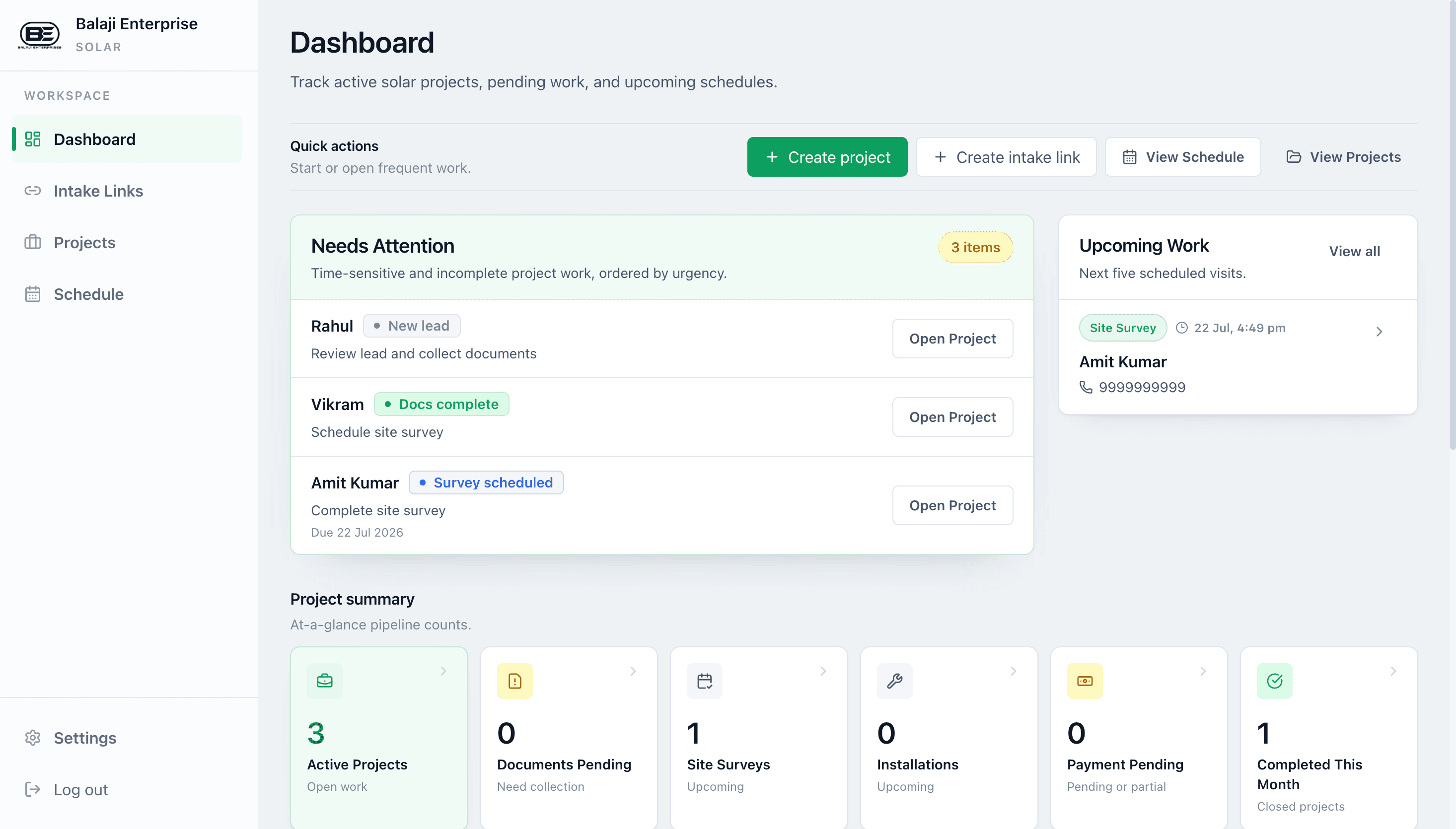
Daily Operations Dashboard
The dashboard brings together active projects, urgent tasks, pending work, and upcoming site visits.
Why it matters
Instead of checking multiple chats or asking the team for updates, the owner can immediately see what needs attention today.
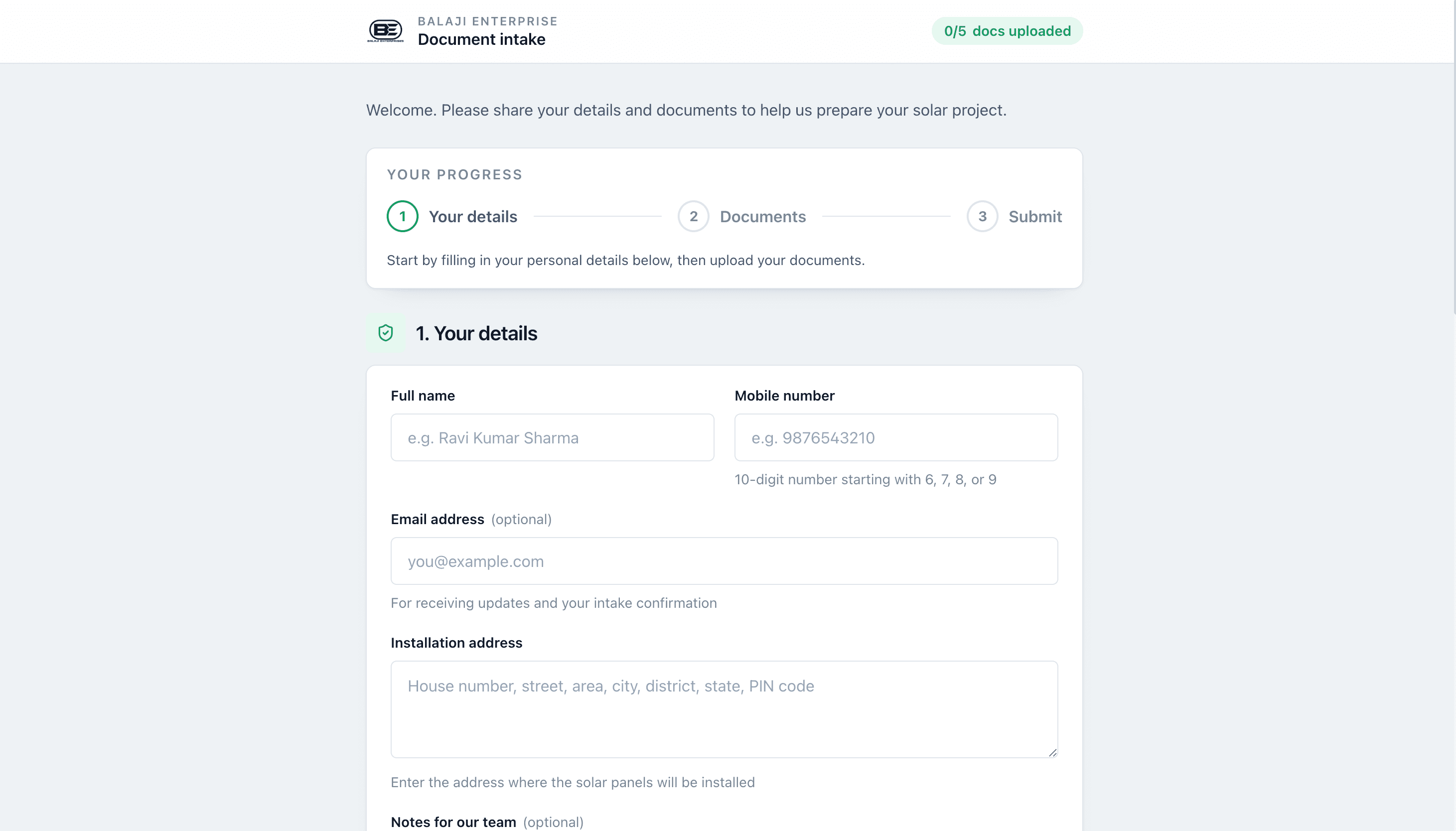
Customer Document Intake
Customers enter their details and upload the required documents through a simple step-by-step form.
Why it matters
Customer information and documents arrive together and are saved against the correct project instead of getting scattered across WhatsApp.
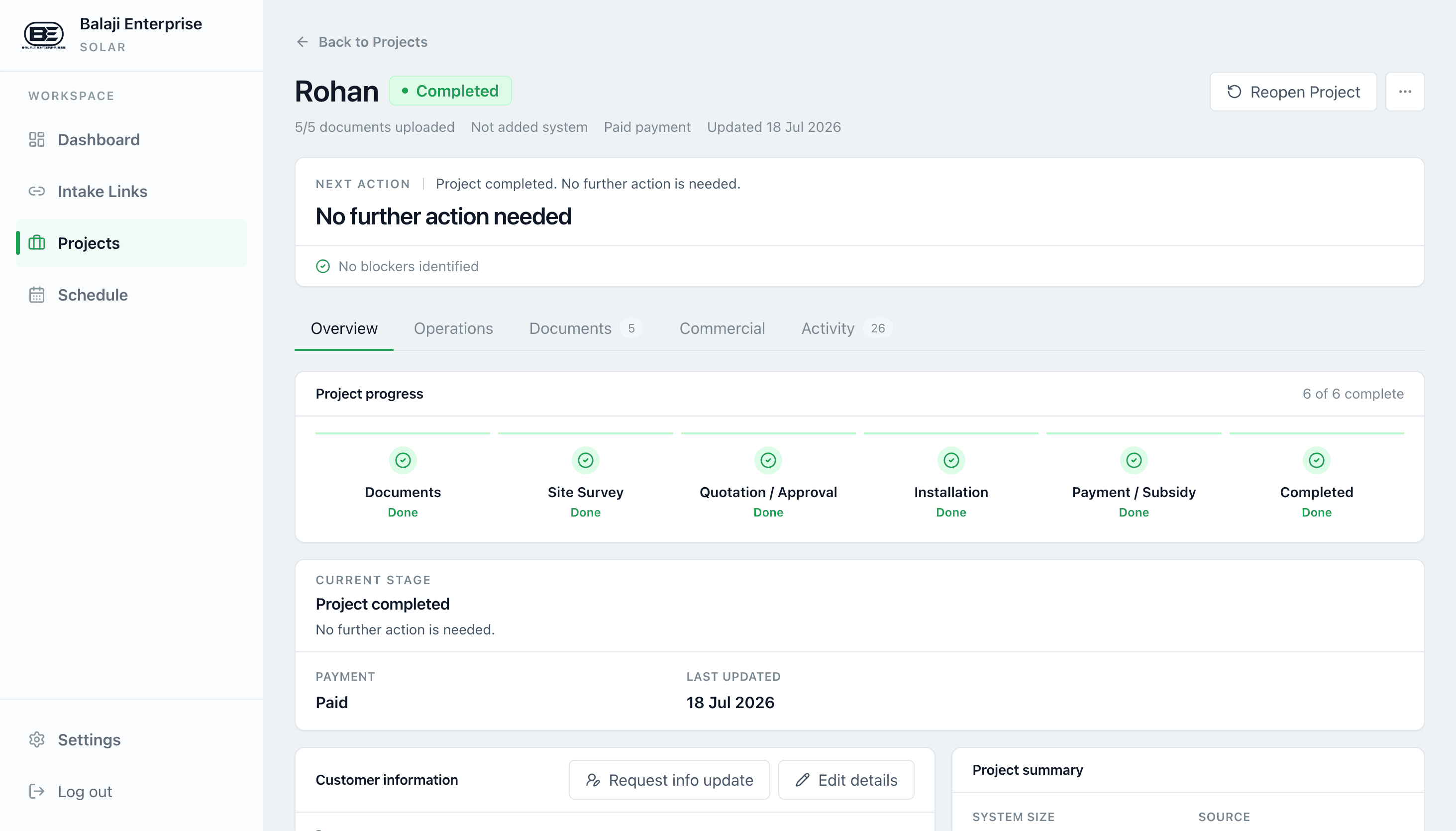
Complete Project View
Each project has one page showing its documents, current stage, upcoming action, quotation, payment status, and activity history.
Why it matters
The team can understand the full state of a project without searching across chats, folders, or separate spreadsheets.
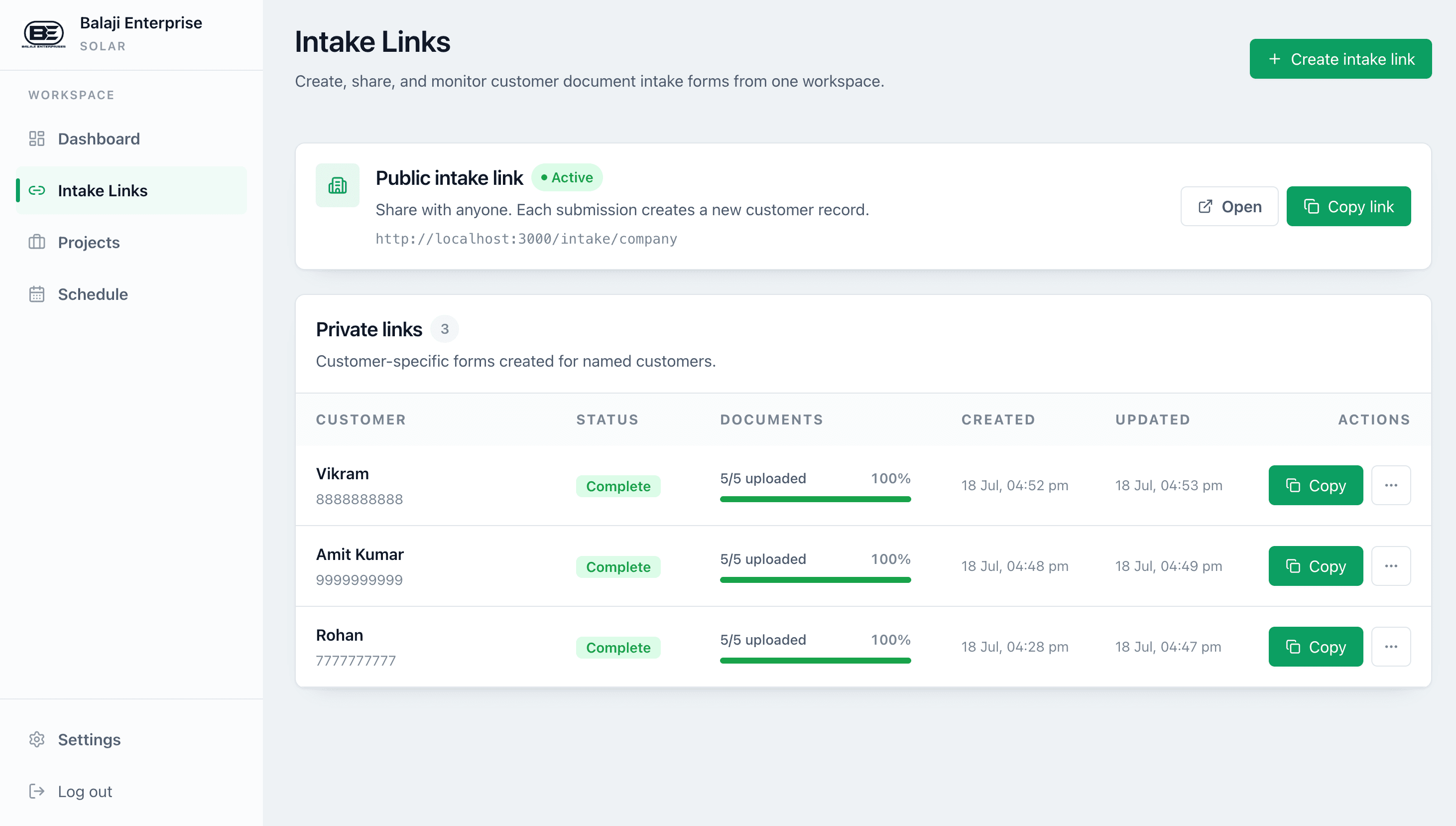
Document Collection Tracking
The team can create customer-specific intake links and monitor how many required documents each customer has uploaded.
Why it matters
Pending customers are easy to identify, so the team knows exactly who needs a follow-up before subsidy or installation work can continue.
Core workflows brought into one system
Customer intake
The team shares one link where customers submit their details and upload all required documents.
Document verification
The team can review submissions, identify missing or incorrect files, and request only the document that needs to be replaced.
Project progression
Each project moves through clear stages: documents, site survey, quotation, installation, payment or subsidy, and completion.
Scheduling and commercial tracking
Site surveys, installations, quotations, approvals, and payments remain connected to the same customer project.
The platform follows the company’s real operational workflow instead of forcing the team to work around generic software.
What changed for the business
One record for every customer
Customer details, documents, project updates, quotations, and payments now stay connected to the correct project.
Faster document follow-ups
The team can quickly see what is missing and request a replacement for one incorrect document without restarting the entire conversation.
Clear daily priorities
The dashboard surfaces pending documents, scheduled surveys, installations, and payment follow-ups that need attention.
Better project visibility
The owner can see how many projects are active, where each one is currently blocked, and what needs to happen next.
* The result is a more structured workflow with less searching, less confusion, and a clearer view of ongoing work.
My role
I worked directly with the business owner to understand how the team handled customers and projects, then planned, designed, and built the complete platform from the initial workflow to the final working application.
Core Responsibilities
What the client said
Very happy with the system. Earlier we were managing documents and project updates on WhatsApp, but now everything is in one place. It is simple to use and built as per our business needs.
Sonu Sahu
Owner, Balaji Enterprise
The same problem exists beyond solar
This type of system can help any operations-heavy business where customer information, documents, tasks, and payments are currently managed through WhatsApp, spreadsheets, and disconnected tools.